



The complete guide to Telecom billing systems (2026 Edition)
Reading time: 10 minutes
1. What is a Telecom Billing System?
Simple Definition
A telecom billing software is the software system (or suite of software) that a mobile operator, fixed-line provider, ISP, MVNO, or 5G/6G network operator uses to accurately charge customers for the services they consume and to generate invoices or deduct balances in real time. In short: it turns network usage into money.
Technical Definition
A Convergent Billing System (CBS) or Online/Offline Charging System (OCS) is a mission-critical, high-throughput platform that ingests usage records (voice, SMS, data, VAS, IoT, content, roaming, etc.), applies product catalog rules, calculates charges, applies discounts and promotions, manages customer accounts, and produces invoices or triggers real-time balance deductions. Modern systems are policy-aware (PCRF/PCEF integration), support 3GPP standards (Gy, Ro, Rf, Sy), and increasingly act as a digital monetization platform for B2B, B2B2X, and partner revenue share.
2. How the Core Processes Fit Together
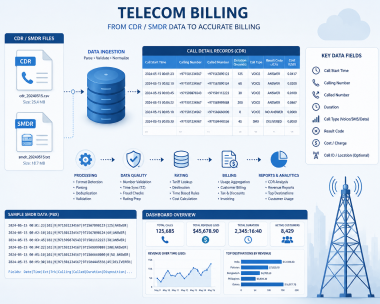
The classic telecom billing value chain consists of four major stages that usually run on separate but tightly integrated modules:
a) Mediation
– Collects raw usage data (CDRs, IPDRs, xDRs, event logs) from network elements (switches, GGSN/PGW/U PF, OCS, IMS, DPI probes, IoT platforms, 5G UDR, etc.).
– Performs de-duplication, validation, correlation, enrichment (adds IMSI, location, tariff plan, etc.), aggregation, and formatting.
– Output: normalized Usage Data Records (UDRs) ready for rating.
– Modern mediation is stream-based (Kafka, Pulsar) and handles 100k–1M+ events/sec with sub-second latency.
b) Rating & Charging
– Rating Engine: takes a UDR, looks up the product catalog and customer tariff, and calculates the monetary (or non-monetary) cost.
– Charging Engine: applies the rated amount to the customer account.
– Offline Charging: batch/post-event deduction (typical postpaid).
– Online Charging (OCS): real-time reservation, deduction, and threshold control (typical prepaid and increasingly postpaid “hybrid”).
– Supports complex rating: zoned, time-of-day, volume tiers, tapered rates, fair-usage policies, shared data buckets, family plans, sponsorship, zero-rating, etc.
c) Invoicing & Billing
– Takes all rated and charged events for a billing cycle, applies cycle fees, one-time fees, adjustments, taxes, early-termination fees, etc.
– Generates PDF/HTML invoices, feeds finance/ERP systems, produces files for payment gateways or direct debit.
d) Payments & Collections
– Often considered part of the billing stack or a separate CRM module.
– Handles credit cards, wallets, direct carrier billing, bank transfers, dunning, write-offs.
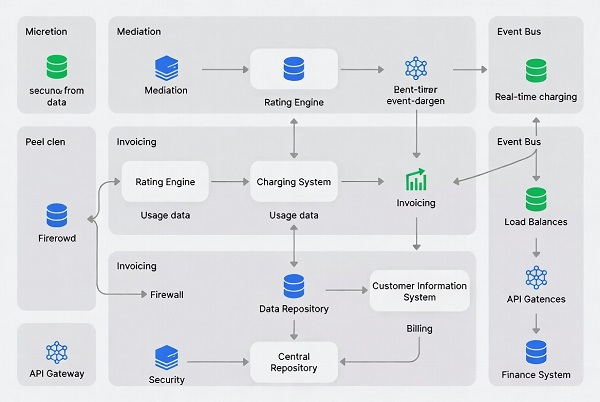
The full flow: Network → Mediation → Rating → Charging → (real-time feedback to network if OCS) → Account balance update → Monthly invoicing → Payment.
3. Postpaid vs Prepaid vs Hybrid (Convergent)
| Feature | Traditional Postpaid | Traditional Prepaid | Modern Convergent/Hybrid |
|---|---|---|---|
| Payment timing | Pay after consumption | Pay before consumption | Both (single account) |
| Credit risk | High (operator extends credit) | None | Controlled via spending limits |
| Real-time control | Usually not | Mandatory | Yes, even for postpaid users |
| Invoicing | Monthly paper/PDF | Top-up receipts | Single invoice for all services |
| Typical use case 2026 | Declining in consumer segment | Still dominant in emerging markets | Dominant model globally |
By 2026, pure postpaid is rare in consumer mobile; almost everyone runs a convergent platform where every subscriber has a real-time balance and spending limits (control accounts) regardless of whether they receive a monthly bill.
4. Usage-Based Billing Models in 2026
– Classic volume or duration (GB, minutes, SMS)
– Speed-tier + fair usage policy (unlimited after FUP throttle)
– Zero-rating & sponsored data (Facebook Flex, WhatsApp bundles)
– Application-based charging (charge differently for YouTube vs email)
– 5G Network Slicing monetization (charge enterprises per slice QoS)
– IoT/M2M differentiated rating (some devices pay per message, others per KB)
– Edge computing usage billing
– Quality-on-Demand (temporary 4K streaming boost for extra fee)
5. Real-Time Charging (Online Charging System – OCS)
The heart of modern telecom monetization. 3GPP-defined interfaces:
– Ro (diameter) – legacy 2G/3G/4G
– Gy – credit-control for packet switched (still widely used)
– Sy – spending limit control
– Nchf – HTTP/2 Converged Charging in 5G SBA
Key capabilities in 2026:
– Sub-50 ms latency reservation/granting
– Unit reservation for voice (seconds), data (KB/MB), events
– Multi-bucket balances (promo data, bonus minutes, rollover, shared family buckets)
– Real-time notifications (SMS/email/push when 50%/80%/100% consumed)
– Integration with 5G Policy Control (PCF) for dynamic QoS changes when balance exhausted
6. Typical Components of a Modern Billing Stack (2026)
– Active Product Catalog – central source of truth for all offers, prices, eligibility rules.
– Stream Mediation Layer (Kafka + Flink/Spark Streaming)
– Rating Engine (custom high-performance or COTS like Amdocs, Optiva, Ericsson Billing, MATRIXX, Cerillion)
– Converged Charging (OCS + offline)
– Balance Management & Account Hierarchy (family plans, corporate accounts, IoT groups)
– Policy Integration (PCRF/PCF linkage)
– Invoicing & Presentment (PDF, HTML5, mobile app)
– Partner & Settlement (interconnect, roaming, content providers, revenue share)
– Taxation Engine (hundreds of geo-tax rules)
– Customer Experience Layer (self-care portal, APIs for CRM)
– Analytics & BI (usage patterns, churn prediction, upsell recommendations)
7. Common Challenges in Telecom Billing (Still Relevant in 2026)
a. Data Volume & Velocity
· 5G + IoT = explosion of xDRs (some operators see >10 billion events/day).
b. Accuracy & Dispute Rate
· A 0.01% rating error on millions of subscribers = millions in revenue leakage or overbilling.
c. Time-to-Market for New Offers
· Legacy Telecom billing software systems require weeks of IT change requests; modern operators launch daily campaigns.
d. Multi-Play Convergence
· Billing fixed broadband, mobile, TV, energy, insurance on one invoice with shared promotions.
e. Regulatory Compliance
· GDPR, net neutrality, emergency service fee collection, lawful intercept cost recovery.
f. Legacy System Debt
· Many tier-1 operators still run 20-30 year old mainframe billing; migration costs billions.
g. Roaming & Interconnect Settlement
· TAP files, NRTRDE fraud detection, 5G roaming data clearing.
h. Fraud & Revenue Assurance
· Bypass fraud, SIM box, wangiri, IRSF (International Revenue Share Fraud).
8. Modern Architecture Trends (2026)
Cloud-Native is the Default
– 90%+ of new deployments and most greenfield operators (Rakuten, Dish, 1NCE) are 100% cloud-native.
– Kubernetes orchestration, stateless microservices, CI/CD launch in hours.
Microservices + Domain-Driven Design
Typical bounded contexts:
– Catalog & Offer Management
– Mediation
– Rating
– Charging & Balance
– Invoicing
– Partner Management
– Customer & Account
API-First / TM Forum Open API
– All functions exposed via REST/GraphQL/gRPC.
– Enables CSPs to become platform players (partner onboarding in days).
Event-Driven Architecture
– Kafka or Pulsar as the central nervous system.
– Every usage event, balance change, product launch is an event.
Serverless Rating for Burst Scenarios
– Some operators run rating on AWS Lambda / Azure Functions for marketing campaigns with unpredictable load.
5G Stand-Alone (SA) Converged Charging Function (CHF)
– Fully cloud-native HTTP/2 interface.
– Replaces legacy OCS for new 5G core deployments.
Low-Code / No-Code Catalog Tools
– Business analysts (not developers) create complex bundles using drag-and-drop.
AI/ML Integration
– Anomaly detection in CDRs
– Dynamic pricing (surge pricing for events)
– Churn prediction → proactive bonus offers
– Automated revenue assurance
Blockchain / Smart Contracts (niche but growing)
– Used for instant roaming settlement (GSMA BCE) and transparent content provider revenue share.
Conclusion
In 2026, the Telecom billing software system has evolved from a back-office cost center into the central digital monetization platform of the operator. The winners are those who achieved:
– Real-time everything (charging, offers, notifications)
– Cloud-native agility
– API exposure for partners
– Single convergent platform for every customer type (consumer, enterprise, IoT)
The old mantra “billing is hard” is being replaced by “monetization is our superpower.” Operators who treat billing as a strategic asset rather than a legacy burden are the ones launching 24-hour NFT plans, 5G slice marketplaces, and embedded finance products that competitors can only dream of.
The future of telecom revenue is no longer about minutes and megabytes; it’s about imagination, speed, and a modern, cloud-native billing stack that can keep up.
Dynasoft thanks to its Cloud-based portal and Desktop billing systems will help you get ready in the best possible way for the challenges and opportunites that lie ahead.