



Ten requirements of a good Telecom billing software
Reading time: 8 minutes
Below is a list of the ten most common requirements that a quality Telecom billing system should be able to satisfy. We are happy to say both TeleFactura and our cloud-based portal TelecomBilling.net meet all requirements.
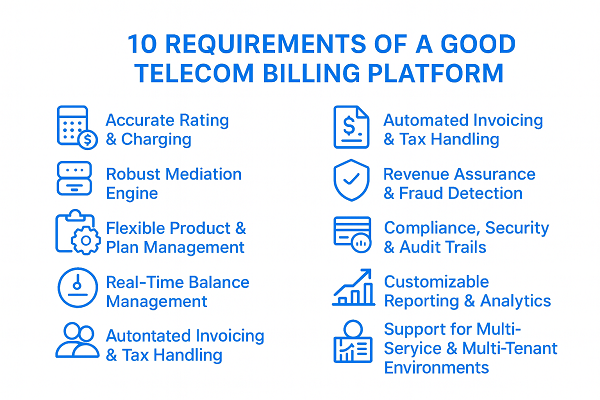
1. Accurate Rating & Charging
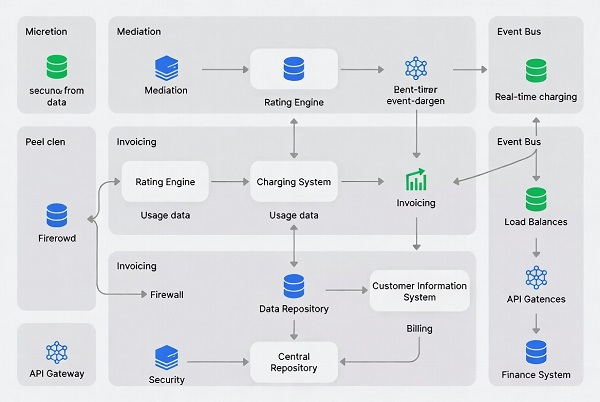
Must handle complex rating rules (tiered, time-based, usage-based, event-based) with high precision and real-time or near-real-time processing.
2. Robust Mediation Engine
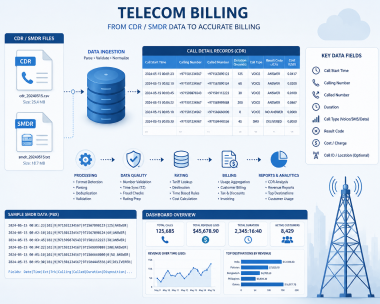
Capable of ingesting CDRs/EDRs/MDRs from multiple network elements, normalizing, deduplicating, and validating data at scale.
3. Flexible Product & Plan Management
Should allow quick creation of new plans, bundles, discounts, and promotions without code changes.
4. Real-Time Balance Management
Required for prepaid users and hybrid models—immediate balance updates, credit control, and session handling.
5. Automated Invoicing & Tax Handling
Generates itemized invoices with correct taxes (VAT, GST, local levies), multi-currency support, and scheduled billing cycles.
6. Revenue Assurance & Fraud Detection
Tools to detect leakage, validate usage vs. billing, flag anomalies, and support auditing.
7. Scalability & High Availability
Should support millions of subscribers, elastic scaling, redundancy, and minimal downtime.
8. Compliance, Security & Audit Trails
Must meet data protection rules (GDPR, PCI-DSS for payments), ensure secure access, and track all billing-critical actions.
9. Customizable Reporting & Analytics
The platform should offer detailed, customizable reporting tools that allow users to generate financial, operational, and usage reports. It should support both real-time and historical data analysis to track KPIs, trends, and customer behavior.
10. Support for Multi-Service & Multi-Tenant Environments
A Telecom billing platform should be capable of managing multiple service types (voice, data, video, IoT, etc.) under a single instance, as well as support multi-tenancy for businesses offering services to different customer groups or resellers. This ensures flexibility and efficient resource management across varied offerings and customer bases.