


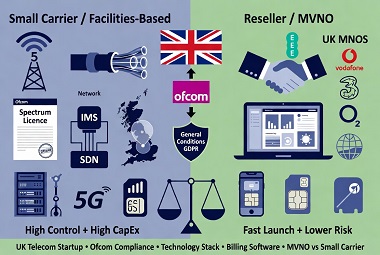

How to set up and run a successful Telecom business
Setting Up and Running a Successful Telecom Business: Small Carrier vs. Reseller
The telecom industry offers two primary entry points for entrepreneurs: operating as a small facilities-based carrier (building and owning network infrastructure) or as a reseller, often called a Mobile Virtual Network Operator (MVNO) or service reseller (leasing capacity from larger carriers). Both models can succeed with strong market research, regulatory compliance, customer focus, and differentiation, but they differ dramatically in capital requirements, operational complexity, timelines, and risks. A small carrier demands heavy upfront investment and technical control, while a reseller prioritizes branding, sales, and partnerships for faster, lower-cost entry. Success in either hinges on niche targeting (e.g., rural areas, specific demographics, or enterprise bundles), reliable service, competitive pricing, and robust customer support.
Operating as a Small Carrier
Launching as a small carrier—such as a regional wireless provider, ISP, or cable operator—requires owning or building physical infrastructure like cell towers, fiber lines, spectrum rights, or switching equipment. This model offers greater control over quality, pricing margins, and innovation but carries significant barriers.
Key setup requirements include:
- Regulatory approvals: In the US, register with the FCC as a telecommunications carrier via Form 499-A (and annual updates). Obtain spectrum licenses (often via auctions or leasing), Operating Company Number (OCN), and state Public Utility Commission (PUC) authorizations where needed. Local permits for tower construction, franchises (for cable), and compliance with rules on robocall mitigation, STIR/SHAKEN, Truth-in-Billing, and consumer protections are mandatory. International or other markets require equivalent national regulator approvals (e.g., spectrum from bodies like Ofcom or ICASA). More on the process of getting regulatory approval for the UK is given further down this article.
- Capital and infrastructure: Expect $200,000–$5 million+ initially for a small-scale launch, covering equipment, site acquisition, backhaul, core network, and ongoing maintenance. Funding often comes from SBA loans, venture capital, or grants. Hire radio engineers, network technicians, and compliance experts early.
- Technology Selection: Critical for viability. Choose scalable infrastructure—fiber optics for backhaul/fronthaul in 5G deployments, small cells for dense coverage, or SDN/NFV for flexible routing. Decide on core network (IMS for VoIP/5G), radio access technology, and future-proofing (e.g., support for eSIM, network slicing). Poor choices lead to high upgrade costs or performance issues; prioritize vendors offering open RAN or cloud integration for cost efficiency and rapid 5G rollout.
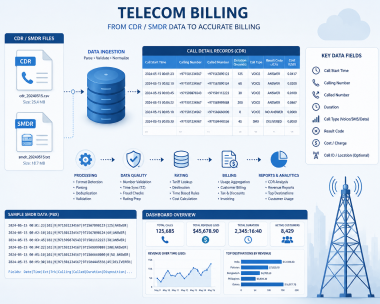
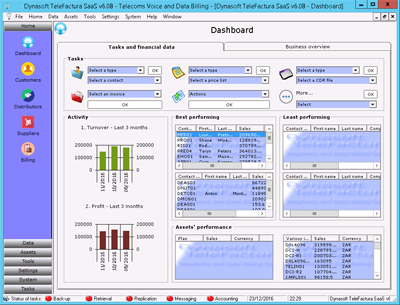
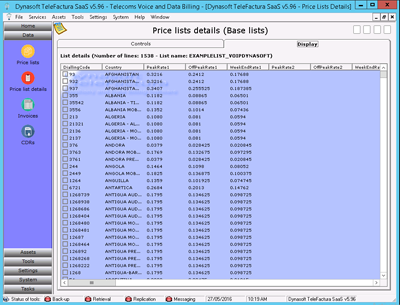
- Billing & OSS/BSS: Invest in robust Business Support Systems (BSS—for billing, CRM, order management, revenue assurance) and Operations Support Systems (OSS—for network monitoring, provisioning, fault management). Modern cloud-based or “as-a-service” platforms enable real-time rating, convergent billing (voice/data/SMS/IoT), and analytics. Selection criteria include integration ease, scalability, real-time processing, and security to handle complex tariffs without errors. Dynasoft can help you fully tap into the potential offered by our Telecom billing portal.
- Business operations: Develop a detailed plan covering market research (target underserved areas), services (voice, data, broadband), billing systems, customer service platforms, and marketing. Build or lease network elements, ensure redundancy for uptime, and scale coverage gradually.
Ongoing success factors: Focus on reliability and local service advantages over national giants. Challenges include high ongoing CapEx for upgrades (e.g., 5G/6G), competition, and regulatory filings. Break-even may take years; aim for 5,000–20,000+ subscribers depending on scale. Strong technical teams and partnerships for roaming or interconnection are essential.
Operating as a Reseller (MVNO)
Resellers or MVNOs avoid infrastructure ownership by purchasing wholesale airtime, data, and voice capacity from major Mobile Network Operators (MNOs) like Verizon, AT&T, or T-Mobile (or via MVNE enablers). This lowers barriers dramatically, enabling launches in weeks rather than years, but introduces dependency on host networks.
Key setup requirements include:
- Regulatory and legal: FCC registration (Form 499, OCN), state resale certificates (potentially all 50 states—legal fees can reach $100,000+), and compliance with the same consumer rules as carriers (billing transparency, robocall mitigation plans in the Robocall Mitigation Database, annual HAC Form 855 for wireless). No spectrum licenses needed.
- Partnerships and costs: Negotiate wholesale agreements with an MNO or MVNE. Choose your model—branded reseller (lowest cost, least control), light MVNO (own billing/CRM), or full MVNO (own core network). Startup costs range from $50,000–$150,000 for basic resellers to $100,000–$400,000+ for light MVNOs (including platform setup, SIMs, marketing). Many providers offer white-label turnkey solutions with APIs for billing and portals.
- Technology Selection: Critical for viability. Choose scalable infrastructure—fiber optics for backhaul/fronthaul in 5G deployments, small cells for dense coverage, or SDN/NFV for flexible routing. Decide on core network (IMS for VoIP/5G), radio access technology, and future-proofing (e.g., support for eSIM, network slicing). Poor choices lead to high upgrade costs or performance issues; prioritize vendors offering open RAN or cloud integration for cost efficiency and rapid 5G rollout.
- Billing & OSS/BSS: Invest in robust Business Support Systems (BSS—for billing, CRM, order management, revenue assurance) and Operations Support Systems (OSS—for network monitoring, provisioning, fault management). Modern cloud-based or “as-a-service” platforms enable real-time rating, convergent billing (voice/data/SMS/IoT), and analytics. Selection criteria include integration ease, scalability, real-time processing, and security to handle complex tariffs without errors. TelecomBilling.Net is fully suited to MVNOs and any other operator or carrier looking for a Telecom billing solution.
- Operations: Conduct market research to define a niche (e.g., budget plans, IoT, ethnic communities). Focus on branding, pricing strategy, customer acquisition (digital marketing, affiliates), CRM, support, and analytics. Launch with host network coverage already in place.
Ongoing success factors: Margins are thinner (wholesale discounts apply), so excel in customer experience, flexible plans, and loyalty programs. Scale requires 5,000–50,000+ subscribers for profitability. Monitor host SLAs for quality; diversify hosts if possible. Fast iteration on bundles and apps drives retention.
Comparison and Shared Success Elements
A small carrier demands 10–100x more capital and 1–3+ years to launch but yields higher long-term control and potential margins. A reseller launches in 30–90 days with far lower risk but relies on host networks for coverage and faces intense competition. Both require FCC/state compliance, a solid business plan, funding, and ongoing filings (e.g., annual revenue reports). Cybersecurity, data privacy (e.g., CPRA/GDPR equivalents), and adaptability to tech shifts (VoIP, eSIM, 5G) are non-negotiable.For success in either path: Prioritize a unique value proposition, invest in digital marketing and excellent support, track metrics like churn and ARPU, and maintain financial buffers. Consult telecom attorneys and MVNE partners early. With disciplined execution, both models reward customer-centric operators in a $1.5+ trillion global market.
Process of Getting Regulatory Approval in the UK
The process for obtaining regulatory approval to operate a telecom business in the UK is relatively straightforward and business-friendly compared to many countries. The UK operates under a General Authorisation Regime (not an individual licensing system for most services), established by the Communications Act 2003. This means you generally do not need a specific licence from Ofcom (the UK communications regulator) to provide electronic communications networks (ECNs) or services (ECSs), such as voice, data, broadband, or mobile services — whether as a small carrier or a reseller/MVNO.
Step 1: Understand Your Obligations – General Conditions of Entitlement (GCs)
All providers of electronic communications networks or services in the UK must comply with Ofcom’s General Conditions of Entitlement (GCs) from the moment they start offering services to customers. These are the core “rules of the game” and cover areas such as:
- Consumer protection (e.g., sales and marketing rules, billing transparency, complaints handling)
- Access and interconnection
- Numbering and portability
- Emergency calls (999/112)
- Security and resilience
- Accessibility for disabled users
- Robocall mitigation and nuisance calls
The exact GCs that apply depend on the type of service (fixed, mobile, broadband, voice, etc.) and customer base (residential vs. business). You must self-assess which conditions apply to your operations. Ofcom publishes the full, up-to-date list of GCs on its website.
No prior notification or approval is required before you start providing services, provided you comply with the GCs. However, many new providers choose to notify Ofcom voluntarily for clarity and to appear on Ofcom’s public register of communications providers.
Step 2: Additional Requirements Depending on Your Model
For Resellers / MVNOs:
- No spectrum licence is needed, as you use wholesale capacity from a host Mobile Network Operator (MNO) such as EE, Vodafone, O2, or Three.
- You operate under the same General Authorisation Regime as any other communications provider.
- If your service uses telephone numbers, you may need a numbering allocation from Ofcom (apply via Ofcom’s online portal). Many MVNOs use numbers allocated to their host MNO instead.
For Small Facilities-Based Carriers (owning infrastructure):
- Spectrum licences are required if you use radio frequencies (e.g., for mobile, fixed wireless access, or private networks). Apply through Ofcom’s licensing portal for the relevant band (shared access licences are available in several bands for lower-power or localised use; national licences are rarer and often awarded via auction or competitive process).
- Code Powers (under the Electronic Communications Code) may be needed if you want rights to install infrastructure on public or private land without full landowner consent. This is a separate application to Ofcom.
- For fibre or fixed-line builds, planning permissions and wayleave agreements are often required from local authorities, but these are not Ofcom matters.
Step 3: Other Practical and Compliance Steps
- Company Setup — Register your limited company with Companies House if not already done.
- Data Protection & Privacy — Register with the Information Commissioner’s Office (ICO) if you process personal data and comply with UK GDPR.
- Anti-Spam / Nuisance Calls — Register a robocall mitigation plan if providing voice services.
- Numbering — Apply for geographic, non-geographic, or mobile number ranges if needed (Ofcom charges annual fees based on the range size).
- Administrative Charges — Ofcom may charge annual administrative fees based on your relevant turnover once you reach a certain threshold.
- Ongoing Compliance — Monitor Ofcom updates, respond to information requests, and prepare for audits. Significant market power (SMP) obligations are unlikely for small/new entrants.
Typical Timeline and Costs
- General Authorisation: Immediate — you can start trading as soon as you are ready and compliant (often within weeks for an MVNO).
- Numbering Allocation: 4–8 weeks typical.
- Spectrum/Shared Access Licence: 4–12 weeks depending on type; fees vary from tens to thousands of pounds annually.
- Code Powers: Several months.
Legal and consultancy fees for reviewing GC applicability, drafting customer terms, and host agreements (for MVNOs) are common upfront costs. Engaging a specialist telecoms solicitor early is strongly recommended to avoid compliance pitfalls.
Key Resources
- Ofcom General Conditions: Search “General Conditions of Entitlement” on ofcom.org.uk
- Spectrum licensing portal and guidance
- Ofcom contact for new providers via their industry guidance pages
In summary, the UK’s light-touch regime allows quick market entry for both small carriers and resellers, with the main focus on self-compliance with the General Conditions rather than lengthy approval processes. Always verify the latest rules on the Ofcom website, as conditions can be updated (e.g., recent changes around security, switching, and emerging technologies like direct-to-device satellite services).